Advanced diagnostics
See more. Plan precisely.
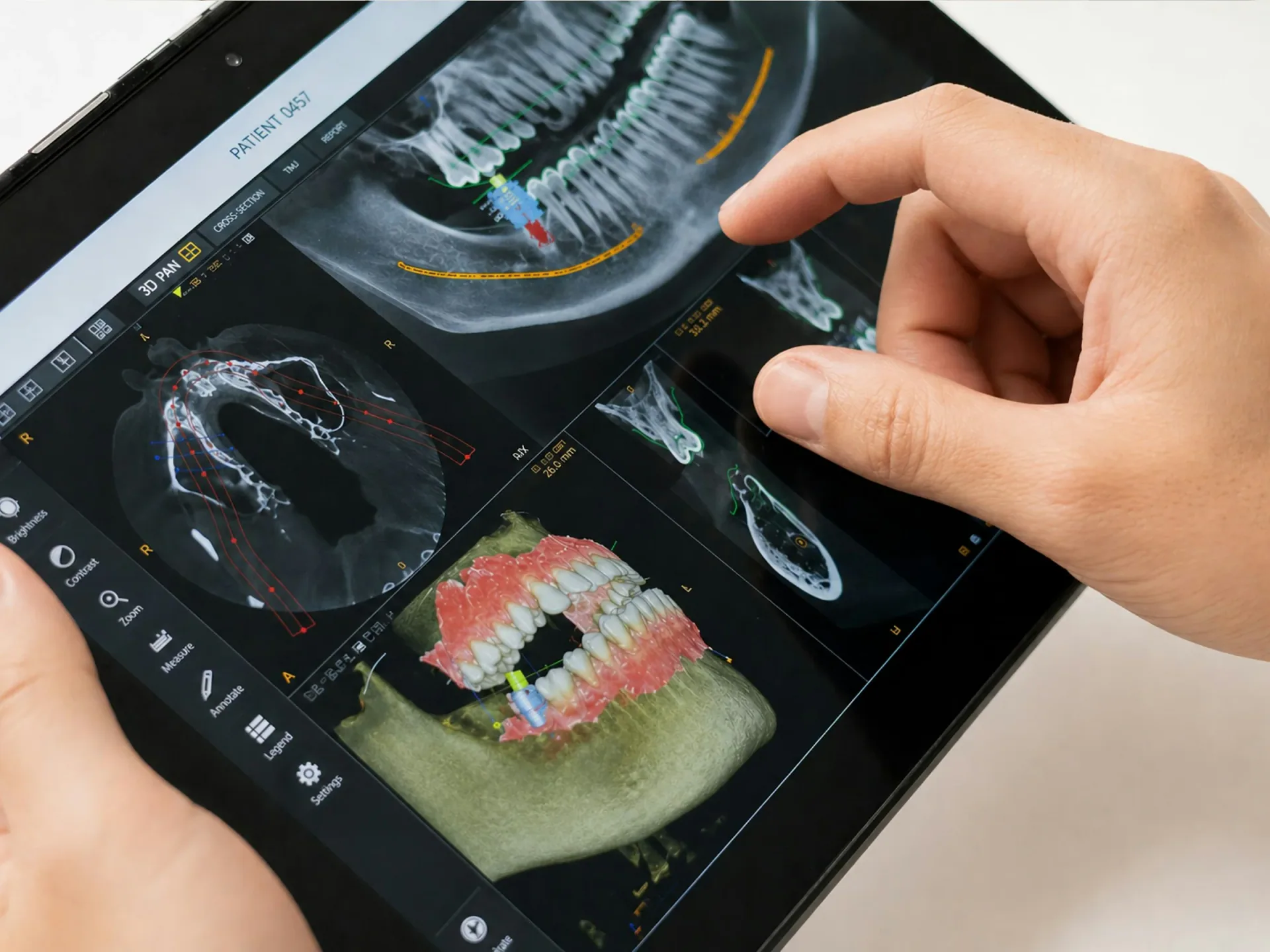
Our PreXion cone-beam CT (CBCT) system creates detailed three-dimensional views of your dental anatomy: length, width and depth. That clarity supports accurate diagnosis and careful treatment planning, with radiation exposure kept to a minimum.
Why 3D matters
Beyond the flat X-ray
A traditional X-ray compresses your anatomy into two dimensions. A CBCT scan adds depth, showing the precise relationship between teeth, bone, nerves and sinuses.
Dental implant planning
Measuring bone height, width and density, and locating nerves and sinuses, so implants can be positioned precisely, including full-arch All-on-X cases.
Complex root problems
Revealing hidden canals, infections or fractures that a flat X-ray can miss.
Wisdom teeth and extractions
Showing the relationship between impacted teeth and nearby nerves before treatment.
Questions
3D imaging, answered
What is a CBCT scan?
A cone-beam CT (CBCT) scan is a 3D X-ray of your teeth, jaw and surrounding structures. Unlike a traditional 2D X-ray, it adds depth, so we can view anatomy from every angle.
Is CBCT imaging safe?
Our PreXion CBCT system is designed to minimize radiation exposure while still producing the detail needed for diagnosis. We only recommend a 3D scan when the extra information will meaningfully guide your care.
Does a CBCT scan hurt?
No. You stand or sit still for a few moments while the scanner rotates around your head. Nothing touches your teeth.
Will every patient need a 3D scan?
No. Most routine visits use low-dose digital radiography. CBCT is reserved for situations such as implant planning or complicated root problems where three-dimensional detail matters.

Your visit
Let’s begin with a conversation.
Tell us what you’d like to change, or simply that it’s been a while. We’ll take it from there, unhurried and without judgement.